How Much Chlorine for an Inflatable Hot Tub?
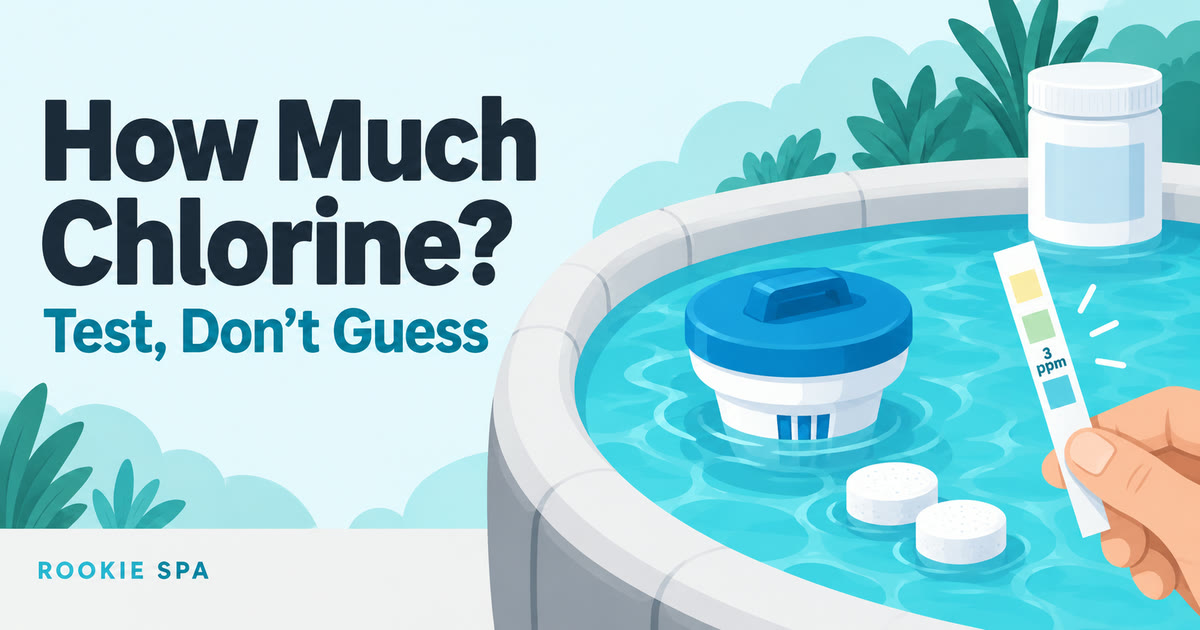
“How much chlorine do I put in?” is the question every new inflatable hot tub owner asks, and almost every answer online is written for a 400-gallon rigid spa. Your tub holds a fraction of that, which means those doses can push you way past where you want to be. Let’s do it properly — by your gallons, in small steps, with a target you can actually hit.
The short answer
Aim for about 3 ppm of free chlorine, and stay within the range your model’s manual gives. The numbers line up like this:
- The CDC recommends at least 3 ppm free chlorine and a pH of 7.0-7.8 for a home hot tub.
- Bestway’s SaluSpa manuals typically call for about 2-4 ppm.
So “around 3 ppm, inside your manual’s range” is a far more solid target than any one-size teaspoon dose. And the golden rule for a small tub: test, don’t guess. Add a little, test, repeat — never dump in a pool-sized scoop and hope.
Why pool and rigid-spa doses over-chlorinate a small tub
A dose is only meaningful against a volume. Instructions written for a 400-500 gallon spa, poured into your 150-300 gallon inflatable, land much higher than intended. Overshoot chlorine and you get harsh, “skunky” water, itchy skin, and faster wear on the liner and components. The small volume is exactly why you scale the dose down and creep up on the target instead of guessing.
Know your gallons first
Everything depends on your tub’s volume, so start there. SaluSpa models run from about 160 gallons (St. Lucia) to around 314 (St. Moritz); a Miami, Cancun, or Tahiti is 177. The full model-by-gallons table is in the beginner water care guide — but always confirm against your own manual, since SKUs and revisions vary.
Start-up dose vs maintenance dose
Two different jobs:
- Start-up (fresh fill): bring brand-new water up into range for the first time.
- Maintenance (day to day): top up to replace the chlorine used up by bathers and time, keeping it at ~3 ppm before you soak.
Both use the same method below — the only difference is the starting point.
First, what your SaluSpa’s manual actually says
Before any dosing math, check how your model wants the chemical delivered — because it’s probably not what the generic pool guides assume. Bestway’s SaluSpa manual is specific: use chlorine or bromine tablets in the chemical dispenser, and “do not use granules.” It warns never to throw tablets directly into the water — they sink onto the liner and can damage and discolor the PVC. Liquid chemicals, by contrast, should be added in small doses in the center of the water, avoiding direct contact with the liner.
So for a by-the-book SaluSpa, “how much chlorine” really means load the dispenser and dial it in — not toss in a scoop. (Plenty of owners do use granular dichlor anyway; if you go that route, know you’re departing from Bestway’s guidance for these models, and never let it settle on the bottom.)
A note on cyanuric acid (why bromine tempts a lot of owners)
Here’s a wrinkle the manual doesn’t get into. Most chlorine tablets are trichlor, and both trichlor and dichlor are stabilized chlorine — they add cyanuric acid (CYA) to the water. The CDC recommends against stabilized chlorine products in hot tubs because CYA slows disinfection, which matters in a small, hot, heavily-used tub. Bromine tablets sidestep the CYA issue entirely, which is exactly why many inflatable owners prefer them. If you do use chlorine tablets, keep an eye on CYA and refresh the water regularly.
What you should flat-out avoid is the tub of pool trichlor tablets from the garage:
Avoid standard pool trichlor tablets in an inflatable hot tub. Trichlor is highly concentrated, acidic, and adds cyanuric acid; the CDC recommends against stabilized chlorine products in hot tubs because cyanuric acid slows disinfection. Some inflatable-spa manufacturers do allow specific small chlorine tablets in their dispensers, so always follow the manual for your exact model and the sanitizer label. Never drop a chlorine tablet directly onto the liner.
Trichlor is also acidic enough to drag your pH down, and below pH 7.0 the CDC notes a rising risk of corrosion.
So how much? The dial-in method
The honest answer is that you reach a target, not a fixed scoop — so you set, test, and adjust:
- Deliver it the way your manual specifies. Tablets go in the dispenser (start with the vents nearly closed); liquid goes in a little at a time with the pump running. Nothing straight onto the liner.
- Circulate. Run the filter — a burst of AirJet helps mix it.
- Wait, then test with a fresh test strip.
- Still low? Open the dispenser vents a bit more, or add a little more liquid, and retest. You can always add more; you can’t easily take it out.
That routine greatly reduces the risk of overshooting — it doesn’t make it impossible (a wrong volume estimate, incomplete mixing, or a misread test can all still trip you up), but creeping up on the target beats guessing every time.
If you use a measured product, the label does the math. As an illustration of how that scales: the label on Leisure Time Spa 56 (a granular sodium dichlor) says ½ oz per 500 gallons for a 2-3 ppm residual — so a 177-gallon tub needs only about a third of that. A little goes a long way at this volume. Read it as how label dosing scales down, not a universal dose — measure with what the label tells you to (don’t eyeball spoons), and remember your SaluSpa manual calls for tablets in the dispenser, not granules.
“But it smells like chlorine” — read this before adding more
The most dangerous instinct in water care is smelling chlorine and adding more. Don’t:
A strong “chlorine” smell usually points to chloramines, not simply too much chlorine. But smell alone can’t tell you whether free chlorine is low or high. Test the water before adding anything.
A well-chlorined tub actually smells faint. That sharp “pool” smell is usually chloramines — combined chlorine formed when chlorine reacts with sweat, oils, and other gunk. It irritates eyes and skin, and it’s a sign to test, not to guess:
If total chlorine is noticeably higher than free chlorine, you have combined chlorine (chloramines). Follow your sanitizer’s shock/oxidation instructions or replace water as appropriate — don’t keep adding chlorine blindly.
One safety catch worth knowing: at very high chlorine levels (above about 10 ppm), some DPD test kits bleach out and read falsely low — even zero. So if a test looks strange right after you’ve dosed heavily, don’t “correct” it with more chlorine. Retest properly first.
What to buy
- The sanitizer your manual specifies — for SaluSpa models, chlorine or bromine tablets sized for the dispenser (bromine avoids the CYA issue). Or a spa-grade liquid chlorine for small-dose top-ups.
- A floating dispenser to hold the tablets (many SaluSpas include one)
- Test strips — free chlorine and pH at minimum; your most important tool
What to skip: pool trichlor tablets, loose granules in a tub whose manual says not to, and anything you’d toss straight onto the liner.
FAQ
How many ppm is safe? Target about 3 ppm free chlorine, within your manual’s stated range (the CDC says at least 3; Bestway typically says 2-4). Keep pH in the 7.0-7.8 zone.
Can I use pool chlorine tablets? Not standard pool trichlor tablets — see above. Use the tablets your manual approves for its dispenser (bromine is a CYA-free option), or a spa-grade liquid chlorine in small doses.
Why does it smell of chlorine? Usually chloramines, not excess chlorine. Test first; if combined chlorine is high, shock or refresh the water rather than piling on more.
How long before I can get in? After dosing, circulate and give it a few minutes, then confirm free chlorine has settled into range before you soak. If you shocked it, wait until it drops back down to ~3 ppm.
Dialed in a dosing routine that works for your model? Tell me your tub and your method — real numbers from real owners make this guide better than any label math.

Jake Weber — Jake Weber is the pen name of Rookie Spa’s editor. I don’t sell spas or chemicals, and I’m not affiliated with any brand. Every guide here starts from the manufacturer’s manual, is cross-checked against the questions and fixes owners report most often, and is written in plain English for first-time owners — with a clear warning whenever something involves electricity or water safety.