Inflatable Hot Tub Won't Heat Past 95°F? Broken or Normal
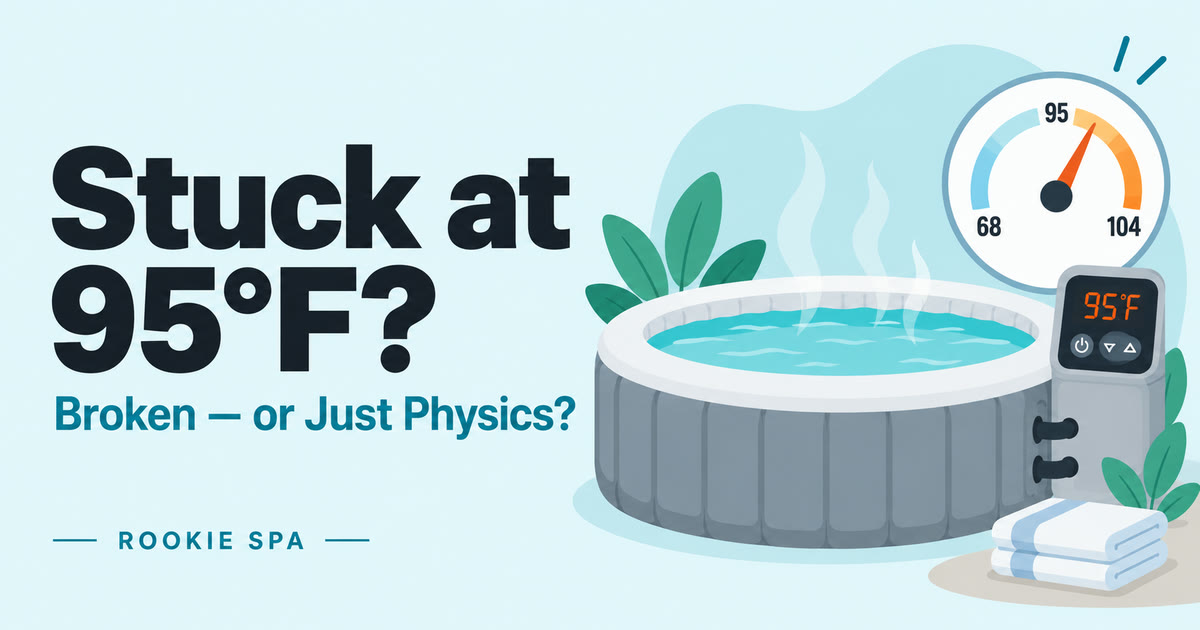
Your inflatable hot tub climbs nicely to about 95°F and then just… sits there. The reviews in your head start writing themselves: cheap junk, broken heater, warranty claim. Hold on. In most cases a tub that stalls at 95°F isn’t broken at all — and one of the reasons is so simple it’s almost embarrassing.
Let’s sort out whether you have a physics problem or an actual fault.
The short answer
A SaluSpa (and most inflatable tubs) tops out at a maximum set temperature of 104°F / 40°C. So 95°F is not the ceiling of the machine. But it can easily be your ceiling — the point where the small heater can’t add heat any faster than your setup loses it. That’s physics, not a fault, and you can usually fix it.
The rare exception is a genuine heater or sensor fault. The 3-question test below sorts the two out — though telling a slow climb from a truly dead heater does mean watching the temperature over a few hours, not a couple of minutes.
Safety note: check your pump against the 2024 recall. In September 2024 the U.S. Consumer Product Safety Commission announced a recall of about 866,000 Bestway AirJet and HydroJet spa pumps sold with SaluSpa, Coleman and Hydro-Force spas from May 2021 to May 2024, because they can overheat and catch fire (recall 24-359). Before troubleshooting anything below, read the model number on the label on the side or back of your pump. The recalled models are P05332, P05339, P05711, P05807, P07000, P07001, P05511, P07034 and P07572. If yours is one of them, stop using it and follow the CPSC recall notice or Bestway’s recall page for a free replacement or a refund. The SaluSpa pump recall guide walks through the label check and what to do next.
First, the embarrassing one: check your set temperature
Out of the box, a SaluSpa’s temperature is set to a default of 95°F (35°C). Plenty of “won’t heat past 95” tubs are simply sitting at the factory default, and the owner never turned the target up.
Press the temperature-up button and watch the display flash to the set value (not the current water temp). If it says 95, that’s your answer — nudge it toward 104 and give it time. If it’s already set above 95 and the water still won’t climb, keep reading.
How these heaters actually work
An inflatable tub heats slowly, and the rate isn’t fixed — figure roughly 2-3°F per hour in mild conditions on a standard 110-120V model, but Bestway notes the heating rate changes with the outdoor temperature and whether the cover is on. Cold air and an open surface both slow it down. (The biggest tubs, like the St. Moritz and Helsinki, are slower still.)
The water temperature you actually reach is a tug-of-war:
heat the element adds − heat your setup loses = where the water settles
When it’s warm out and the cover’s on, the heater wins and you cruise to 104°F. When it’s cold, windy, the cover’s off, or the tub sits on bare concrete, the loss side grows — and the water settles at a lower number. For a lot of people in shoulder-season weather, that settling point lands right around 95°F. Nothing is broken. The heater is just fighting to a draw.
The 3-question test: physics or fault?
1. Is it climbing slowly, or completely flat? If the water is still creeping up (even 1°F every couple of hours), the heater is working — you’re looking at a slow climb or a heat-loss ceiling, not a dead heater. If it’s been stone flat for many hours with the heat icon on, that points more toward a real fault.
2. What are the conditions? Cold air? Windy? Cover off? Tub on bare concrete or tile? Running the AirJet bubbles while you wait? Every one of those pushes your settling point down. If you can say yes to two or more, physics is almost certainly your “fault.”
3. Any error code? If it throws an E02 (flow) or another code, that’s a different problem — the heater won’t run properly if the pump can’t move water. Work the E02 fix checklist first, and see the not-heating guide for the full three cases. For any code you don’t recognize, the SaluSpa error codes guide has the whole table in one place.
If you climbed slowly, in cold/exposed conditions, with no code — you have a heat-loss ceiling, and the next section is for you. If it was flat, in mild weather, cover on, no code — skip to When it’s a real fault.
If it’s physics: clawing back the last degrees
You’re not adding a bigger heater — you’re cutting the losses so the same heater gets further. In rough order of impact:
- Keep the cover on whenever you’re heating. This is the big one. An open surface sheds heat fast, mostly to evaporation. Many owners find the cover alone is the difference between stalling and reaching temperature.
- Add a floating thermal blanket under the cover for extra insulation on the water surface.
- Get it off cold ground. A foam base (interlocking foam tiles or rigid foam board) under the tub stops the concrete from wicking heat out the bottom — owners regularly report a few degrees gained.
- Turn the AirJet off while heating. The bubbles force cold air through the water and mean the cover’s off — great for a soak, bad for climbing the last few degrees. Heat first, bubble later.
- Shelter it from wind. Wind strips heat off the cover and cabinet. A screen, wall, or corner helps.
Stack a few of these and a tub that stalled at 95°F will usually push on toward 104°F — just not quickly. Think overnight, not minutes.
When it’s a real fault
If the water is flat-out not climbing — mild day, cover on, no code, hours in — then you may actually have a bad heating element or temperature sensor. That’s a Bestway support / warranty call with your model number, not a DIY job. The heater runs on mains voltage inside a sealed pump unit; don’t open it. Out of warranty, replacement pump/heater units are a common swap — just match your exact part number, because two units that look identical aren’t always electrically interchangeable.
Quick reference
| What you see | Most likely cause | Do this |
|---|---|---|
| Stuck at 95°F, set temp reads 95 | Still on factory default | Turn the target temperature up |
| Slow climb, cold/windy/cover off | Heat loss beats heater | Cover, blanket, foam base, wind shelter |
| Stalls with bubbles running | AirJet sheds heat | Heat with AirJet off, cover on |
| Throws E02 or another code | Flow/other fault | E02 checklist |
| Flat, warm day, cover on, no code | Possible heater/sensor fault | Bestway support / warranty |
FAQ
What’s the maximum temperature? 104°F (40°C) is the ceiling by design — the same as a “real” hot tub. The tub won’t go higher, and you wouldn’t want it to.
How long from cold to 104°F? Longer than you’d think, and it depends heavily on your starting water temperature. Bestway’s own table (to reach 104°F) runs about:
| Starting water temp | Time to 104°F |
|---|---|
| 50°F (10°C) | ~32 hours |
| 59°F (15°C) | ~26 hours |
| 68°F (20°C) | ~20 hours |
| 77°F (25°C) | ~14 hours |
| 86°F (30°C) | ~9 hours |
So a genuinely cold fill can run well over a day. It’s a marathon — most owners heat overnight (or longer) with the cover on, and cold weather stretches these numbers further.
Is 100°F actually fine to soak in? Honestly, yes — plenty of people soak at 100-102°F and prefer it. If your setup settles a couple of degrees below 104, that’s comfort preference, not a defect.
Does the cover really make that much difference? Yes. Of everything on the list, keeping the cover on while heating is the single biggest lever.
Got a tub that stalls in the cold? Tell me what finally got yours to temperature — every reader setup is a little different, and this guide gets better for it.

Jake Weber — Jake Weber is the pen name of Rookie Spa’s editor. I don’t sell spas or chemicals, and I’m not affiliated with any brand. Every guide here starts from the manufacturer’s manual, is cross-checked against the questions and fixes owners report most often, and is written in plain English for first-time owners — with a clear warning whenever something involves electricity or water safety.