SaluSpa Freeze Shield: What It Does (and Doesn't)
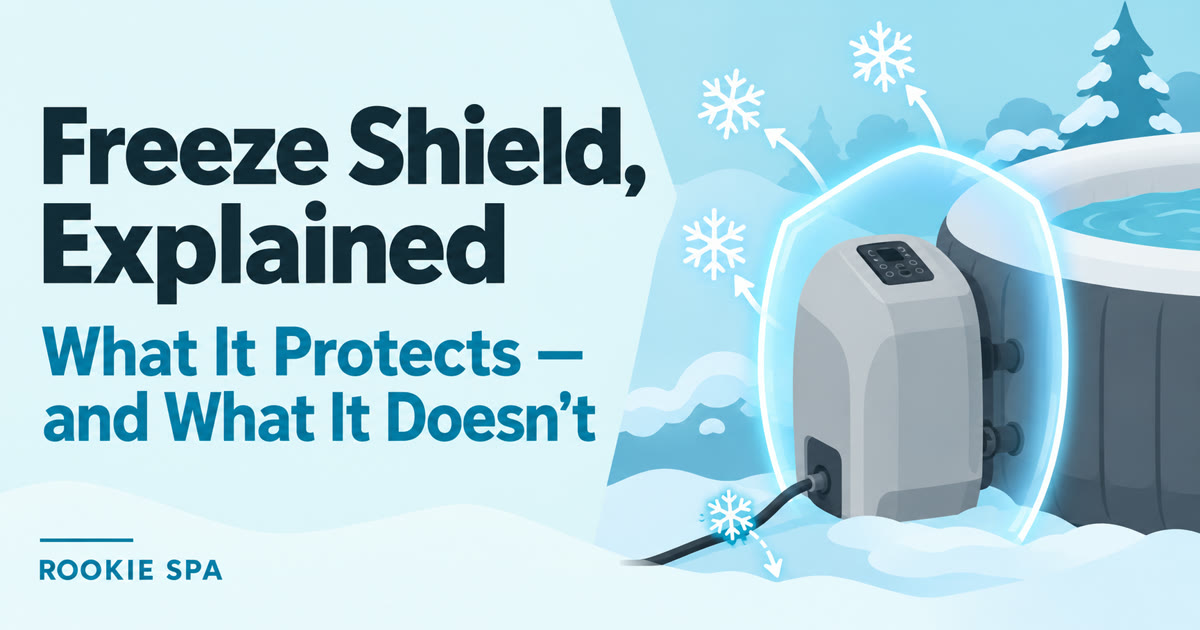
Freeze Shield is the feature that convinces a lot of people their inflatable hot tub is winter-proof. It’s genuinely useful — and genuinely misunderstood. Let me save you an expensive surprise: Freeze Shield protects the machine, not your soak, and only within limits.
Safety note: check your pump against the 2024 recall. In September 2024 the U.S. Consumer Product Safety Commission announced a recall of about 866,000 Bestway AirJet and HydroJet spa pumps sold with SaluSpa, Coleman and Hydro-Force spas from May 2021 to May 2024, because they can overheat and catch fire (recall 24-359). Before troubleshooting anything below, read the model number on the label on the side or back of your pump. The recalled models are P05332, P05339, P05711, P05807, P07000, P07001, P05511, P07034 and P07572. If yours is one of them, stop using it and follow the CPSC recall notice or Bestway’s recall page for a free replacement or a refund. The SaluSpa pump recall guide walks through the label check and what to do next.
What Freeze Shield actually is
On equipped SaluSpa models (UK Lay-Z-Spa units are Bestway too, but their pumps and error codes can differ, so check your own manual), Freeze Shield is an automatic protection cycle: when the water temperature drops toward the danger zone, the tub wakes itself up and runs the pump and heater just enough to keep the internals from freezing.
That’s it. It’s not a winter mode, not a heating boost — it’s a self-defense reflex for the pump and lines.
When it kicks in
The system activates automatically when things get cold. Bestway’s documentation says that once the outside temperature drops below about 43°F (6°C) the heater must always be on, and Freeze Shield works to keep the water in roughly the 43-50°F (6-10°C) band. Be clear on what that band is: it’s an anti-freeze holding range to protect the pump and lines — not a bathing temperature. 43°F water keeps the internals safe; it’s nowhere near warm enough to soak in. Note what the manual doesn’t give: a precise “switches on at X, off at Y” threshold. It guarantees the protective band, not an exact on/off point — so treat any tighter number (including from this page) as a rule of thumb and check your own manual.
There’s also a hard floor: Bestway says not to use the spa once the ambient temperature reaches 14°F (-10°C). Below a certain point the little heater simply can’t win against the cold. That’s “don’t use”, not “switch off”: a full tub below 42.8°F still needs its heater on, so if temperatures like that are normal where you live, drain and store it rather than leaving it full. Freeze Shield is designed for margin cases — cold snaps, shoulder-season frosts — not for riding out a northern January.
If the tub flashes E03 while it’s full and plugged in, the pump is reading the water below 40°F (4°C), under the band Freeze Shield is meant to hold. Treat it as a warning, not as Freeze Shield doing its job: the manual says alarms pop up when Freeze Shield isn’t working. What to do about E03 walks through the manual’s restart rule and when to drain instead.
What it does NOT protect against
This is the section that matters:
- Power cuts. Freeze Shield is software running on mains power. If a winter storm takes your power out for a day, the protection is gone and the water in the pump and lines can freeze and crack the housing. This is the single most common freeze-damage story — and it happens to people who did everything “right.”
- The tub being unplugged or drained low. Obvious once said, but: no power or not enough water = no protection.
- Sustained hard freezes. Below the design range, it delays the damage; it doesn’t prevent it.
- Your warranty, if it fails. Freeze damage is generally considered owner negligence by manufacturers — don’t count on a free replacement.
So can you rely on it?
My honest take, as someone who reads the manuals and the horror stories:
- Mild-winter climates: yes — Freeze Shield plus a cover is a reasonable way to leave the tub out between uses.
- Real-winter climates: treat it as a safety net, not a plan. If sustained freezes are normal where you live, winterize or bring the tub in — draining it takes an afternoon; a split pump housing takes a replacement unit.
FAQ
Does Freeze Shield use a lot of electricity? It runs in bursts, only when needed. Cost is modest in cold snaps but adds up in a long cold spell — at which point you should question whether the tub should still be outside.
Does it work if the tub is unplugged? No. Power and water in the tub are both required.
Which models have it? Bestway features Freeze Shield widely across its current lineup, and many models on sale today include it — but plenty of older units don’t. Don’t assume: your manual (or the model’s spec page) is the only way to be sure, and if yours doesn’t have it, winterizing is your only cold-weather option. The 2017 Coleman 90363 manual, for one, doesn’t mention it. Setting one up in the cold? Check your model first.
Had Freeze Shield save your tub — or fail to? Real winter reports make this guide better.

Jake Weber — Jake Weber is the pen name of Rookie Spa’s editor. I don’t sell spas or chemicals, and I’m not affiliated with any brand. Every guide here starts from the manufacturer’s manual, is cross-checked against the questions and fixes owners report most often, and is written in plain English for first-time owners — with a clear warning whenever something involves electricity or water safety.