How to Insulate an Inflatable Hot Tub for Winter
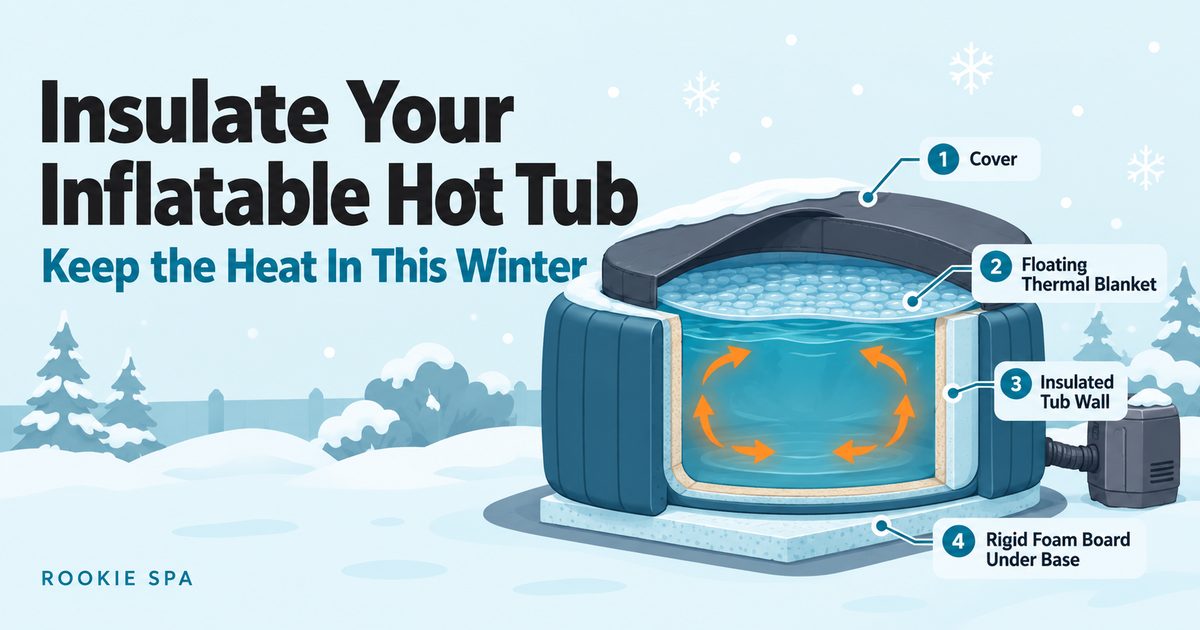
Here’s the order I’d insulate in: keep the cover on every time the heater runs, add a floating thermal blanket under it, set the tub on a firm, level insulating base such as rigid foam board, and block the wind. Just as important is what to leave alone: don’t wrap or box in the pump-heater unit, and never bury or cover its power cord. The manual forbids burying the cord, and the pump has its own thermal cut-out.
Scope note: the manual facts here come from Bestway’s SaluSpa AirJet Plus owner’s manual (Vancouver and Milan, pump S100205). Other SaluSpa and Coleman models can differ in the details, so check yours.
Safety note: check your pump against the 2024 recall. In September 2024 the U.S. Consumer Product Safety Commission announced a recall of about 866,000 Bestway AirJet and HydroJet spa pumps sold with SaluSpa, Coleman and Hydro-Force spas from May 2021 to May 2024, because they can overheat and catch fire (recall 24-359). Before troubleshooting anything below, read the model number on the label on the side or back of your pump. The recalled models are P05332, P05339, P05711, P05807, P07000, P07001, P05511, P07034 and P07572. If yours is one of them, stop using it and follow the CPSC recall notice or Bestway’s recall page for a free replacement or a refund. The SaluSpa pump recall guide walks through the label check and what to do next.
Where does an inflatable hot tub lose heat?
Four places, in plain physics terms (the mechanism, not a measurement):
- The surface, where warm water gives off heat and moisture under the cover.
- The ground, which draws heat out through the tub’s floor.
- The walls, the biggest exposed area on a cold night.
- Wind, which strips heat off every exposed surface faster than still air.
The manual backs up the biggest lever: the heater’s rate may change when the outdoor temperature is below 59°F (15°C) or when the cover isn’t in position while heating. What it doesn’t give is a percentage for each loss, and neither will I. You’ll see “90% of heat is lost through the surface” elsewhere; I haven’t found a source behind it.
Step 1: Keep the cover on every time the heater runs
Straight from the manual: “Be sure to cover the spa with the spa cover whenever the heating function is activated. Leaving the spa uncovered will increase the heating duration required.” Bestway’s winter tips add that the cover helps “hold in the heat, conserve energy and protect from debris.”
- Never run the AirJet with the cover on. The manual warns that air can accumulate inside the spa and cause “irreparable damage to the cover and bodily harm.”
- Fasten it properly. A common owner practice is to check every buckle is clipped and the cover sits snug all the way around.
Step 2: Add a floating thermal blanket under the cover
Many owners who run their tub through winter add a floating thermal blanket, a cut-to-fit sheet that floats on the water under the cover, and say the tub holds heat better with one. Nobody publishes reliable numbers for inflatables, so I won’t invent one. Trim it to your tub’s inside shape.
Take it out before you run the bubbles. The manual doesn’t mention blankets, so this is my reasoning: its rule against running the massage with the cover on is about air building up under what sits on the water, and a blanket sits right there. And it doesn’t replace the cover; it goes under it.
Step 3: Put a firm, level, insulating layer under the base
Cold ground is a heat sink, and foam board underneath is one of the most common owner upgrades. The manual’s rule for the surface is strict: it must be “smooth, flat, level and capable of supporting the weight for the entire time the SaluSpa is installed (not on the carpet or other similar material).” Damage from improper support isn’t covered by the warranty. And the weight is serious: the manual’s specs list 1,833 lb for the Vancouver and 2,103 lb for the Milan, and its surface rule is written around the combined weight of the spa, the water and the people in it.
My pick is rigid foam insulation board, because it’s firm and stays flat:
- Lay it on ground that’s already flat and level, with no gaps between boards, and big enough that the whole floor of the tub sits on it (my practical reading of the flat-and-level rule).
- Check the compressive strength on the product label against what it has to carry. The label is the spec; I’m not going to invent a number.
Interlocking foam mats? The manual doesn’t name them. If they stay firm, flat and level under the full weight, with no dips or gaps, they pass its test; if they compress unevenly, they don’t.
Under the pump too? Fine, as long as the pump sits stable and its adapters stay level with the spa’s. The manual itself says to raise the pump “with wood or another type of insulated material” when they aren’t.
Step 4: Block the wind
Bestway’s winter advice is to put the tub “close to your house with some type of shelter (patio cover, awning, etc.) above it,” or to use a canopy to “help block the cold air coming from the side.” Owners also use windbreak panels on the exposed side. Two manual rules while you build it:
- No electric appliances within 5 feet of the spa: the manual names lights, telephones, radios and TVs, so no plug-in heaters or heat lamps beside it.
- Metal frames: the manual says to install the spa at least 5 feet from metal surfaces unless each one is permanently bonded to the wire connector provided on the unit. That’s an electrician’s job, and worth knowing if your canopy has a metal frame.
Optional: can you insulate the walls with a thermal jacket?
Some owners add an insulating wrap around the outside walls and report better heat retention, again without reliable numbers. Keep it clear of the pump and its connections. A wrap won’t stop the manual’s other winter effect: day-to-night temperature swings change the pressure and can make the spa deflate a little, so keep checking the pressure.
What should you never insulate?
Insulated pump covers are sold online, and some owners box in the pump for noise or winter. Although that’s common, I’d skip it:
| Don’t | Why | Source |
|---|---|---|
| Wrap, box in or cover the pump-heater unit | Its thermal cut-out trips above 122°F (50°C) ambient or in direct sun; the massage blower can overheat (unplug and wait two hours); the 2024 recall was about pumps overheating | Manual + CPSC. The manual doesn’t mention pump covers: “don’t enclose it” is my safety reasoning, not a Bestway rule |
| Bury or cover the power cord or GFCI plug | “Do not bury cord,” and the GFCI must be tested before each use, so you need to reach it | Manual |
| Use an extension cord or multi-plug adapter to move the outlet | They can make the plug overheat; the spa must connect directly to a grounded socket | Manual |
| Leave the cover, or the blanket, on while the AirJet runs | Air builds up underneath: damage and injury risk | Manual (cover); my extension (blanket) |
| Use a soft, uneven or carpet-like base | Surface must be smooth, flat, level and weight-bearing | Manual |
| Put electric heaters or heat lamps near the tub | No electric appliance within 5 feet | Manual |
“Doesn’t the pump need to stay warm in winter?” Not from a jacket. Below 42.8°F (6°C) outside, the manual says the heater must always be on, and Freeze Shield then keeps the internal temperature between 42.8°F and 50°F (6-10°C) to protect the pipes. That runs on power, not insulation: Freeze Shield explained.
Does insulation actually lower the bill?
It should cut the hours your heater runs, but no one can give you a reliable percentage for your tub:
- The manual gives no savings figures for a cover, blanket, board or windbreak. (It mentions insulated material only for leveling the pump.)
- Owners consistently report fewer heater hours once they add a blanket and a base board, without numbers you could rely on.
- Bestway claims the insulated liner-and-cover system of its SaluSpa Hot Springs AirJet (EnergySense) is up to 40% more energy-efficient than similar inflatable hot tubs. That’s a claim about one model’s whole system, not what you’ll get by adding a cover or blanket to yours.
- ENERGY STAR’s figure is about the setting, not insulation: if you use your spa once a week, lowering the temperature three degrees when it’s not in use saves roughly 5-10% of spa heating costs. A general figure with a weekly-use condition, not a SaluSpa number.
To see your own result, use the formula in my running-cost guide and compare electric bills or meter readings before and after. I don’t recommend plug-in energy meters for this: the manual says the spa must connect directly to a grounded socket and warns that adapters can make the plug overheat. It doesn’t mention meters by name, so that’s my inference, but a meter sits between plug and socket the same way.
Insulation also pairs with the power-saving timer, which the manual says lets you heat “without needing to leave the heater on at all times”; Bestway’s FAQ doesn’t suggest running the spa 24/7. The exception is cold weather: with the spa filled and the temperature below 42.8°F (6°C), don’t switch the heater off.
What can’t insulation fix in winter?
It buys you degrees and heater hours. It doesn’t move the manual’s limits:
- Don’t use the spa when the ambient temperature reaches 14°F (-10°C).
- Below 42.8°F (6°C) outside, the heater must stay on, and Freeze Shield only works with power.
- Long absence with a risk of temperatures below 42.8°F? Bestway “strongly suggest[s] disassembling the spa and storing it.”
If that sounds like your winter, read the winter use guide before buying insulation. If your tub climbs but always stalls a few degrees short, check the set point first (it ships at 95°F); the won’t-heat-past-95 guide covers that and the heat-loss ceiling.
Shopping list
Check the fit for your exact model first:
- Floating thermal blanket, trimmed to your tub’s inside shape.
- Rigid foam insulation board (XPS or polyiso), compressive strength checked on the label.
- A replacement cover made for your model, if yours no longer seals.
- Windbreak panels or a canopy.
Not on the list: insulated pump covers or pump boxes.
FAQ
Can I put an inflatable hot tub on foam mats? Only if they stay firm, flat and level under the full weight. The manual requires a smooth, flat, level, weight-bearing surface, and not carpet or similar. I prefer rigid board.
Should I wrap the pump to keep it warm? No, for the reasons in the table above (my safety call, not a manual rule). Freeze Shield protects the pipes as long as the heater has power.
Does a thermal blanket replace the cover? No. The manual’s rule is the cover every time the heater runs; the blanket is an extra layer under it.
Is it better to set it up indoors? The manual allows indoor installation but warns that humidity comes with it and to provide plenty of ventilation. The floor rule still applies.
Insulated your tub a different way, or tracked the difference on your bill? Tell me what you did and what changed. Real winter numbers from readers beat anything a product page promises.

Jake Weber — Jake Weber is the pen name of Rookie Spa’s editor. I don’t sell spas or chemicals, and I’m not affiliated with any brand. Every guide here starts from the manufacturer’s manual, is cross-checked against the questions and fixes owners report most often, and is written in plain English for first-time owners — with a clear warning whenever something involves electricity or water safety.