How to Winterize & Store an Inflatable Hot Tub
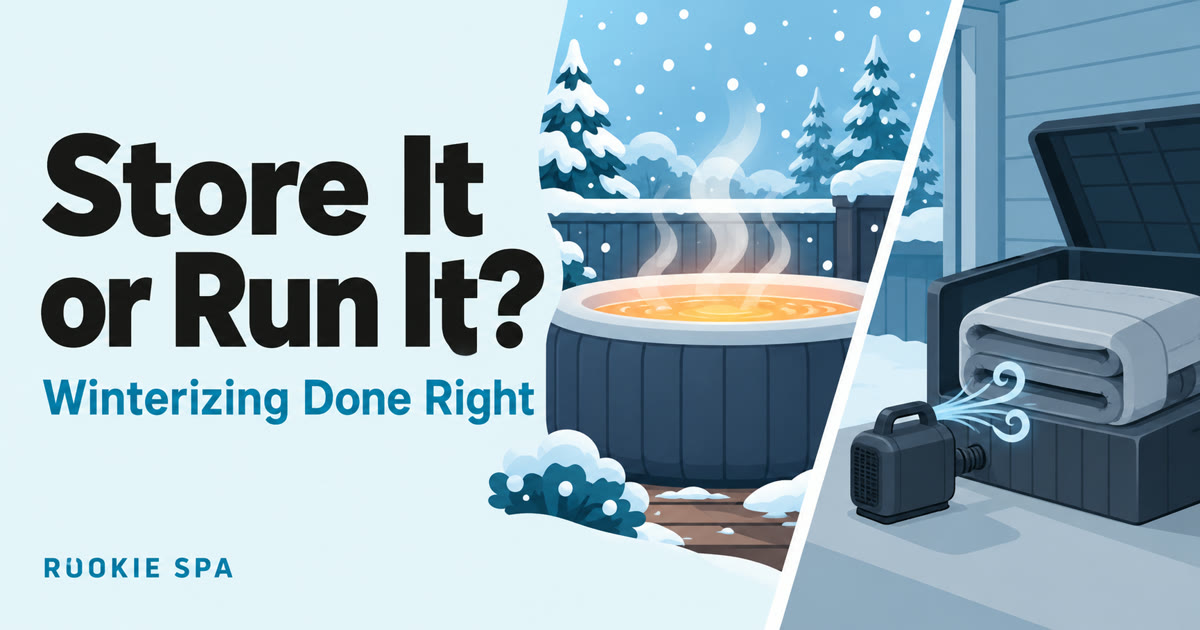
You’ve got two options when cold weather shows up: keep the tub running through winter, or drain it, dry it completely, and store it until spring. If your winters are mild and the tub stays plugged in, running it can work. If sustained freezes are normal where you live, storage is the safe call — and the job itself is simple: drain, clean, dry, blow out the lines, fold it warm, box it up.
This guide covers both paths, but it goes deep on the second one — because that’s where people quietly ruin their spas. Not by freezing them. By packing them away wet.
Should you winterize your inflatable hot tub or keep using it?
Quick decision, honestly framed:
Path A — keep it running. Totally doable in the right climate. The short version: the tub needs to stay filled, powered, and covered, and on Freeze Shield-equipped SaluSpa models the manual says the heater must always be on once the outside temperature drops below about 43°F (6°C) — that’s the point where the automatic protection matters. There’s also a hard floor: Bestway says not to use the spa once it’s 14°F (-10°C) outside. If that’s normal where you live, drain and store it rather than leaving it full. If your pump is on the recall list below, Path A isn’t an option: stop using it, then drain and store the tub. Expect a noticeably higher electric bill, too — a heater fighting winter air runs a lot; the running cost breakdown shows why, and how to insulate an inflatable hot tub covers what helps (and what never to wrap).
If that sounds like your winter, go read the full winter use guide and the Freeze Shield explainer — especially the part about what Freeze Shield doesn’t protect against (spoiler: it runs on the heater, so a power cut stops it).
Path B — drain and store. The right answer if any of these are true:
- Sustained hard freezes are normal in your winter
- You’ll be away for stretches and can’t monitor it (for a long absence when it could drop below 43°F, Bestway strongly suggests disassembling and storing the spa)
- Your winter electric rates make the math ugly
- Your model doesn’t have freeze protection at all
If that’s you, keep reading. The rest of this page is the storage guide.
Safety note: check your pump against the 2024 recall. In September 2024 the U.S. Consumer Product Safety Commission announced a recall of about 866,000 Bestway AirJet and HydroJet spa pumps sold with SaluSpa, Coleman and Hydro-Force spas from May 2021 to May 2024, because they can overheat and catch fire (recall 24-359). Before running or storing anything below, read the model number on the label on the side or back of your pump. The recalled models are P05332, P05339, P05711, P05807, P07000, P07001, P05511, P07034 and P07572. If yours is one of them, stop using it and follow the CPSC recall notice or Bestway’s recall page for a free replacement or a refund. The SaluSpa pump recall guide walks through the label check and what to do next.
How do you winterize an inflatable hot tub? (step by step)
The goal in one sentence: no water anywhere, no moisture in the box, and no folding stiff-cold vinyl. Here’s the order I’d do it in.
1. Pick your day
Do this on a mild, dry day — ideally before real cold arrives. Two reasons: you’ll be air-drying the tub outside, and PVC gets stiff in the cold. Many owners report that folding an inflatable spa when the material is cold and rigid creases it badly and can stress the seams — warm, pliable vinyl folds; cold vinyl fights you. If winter has already landed, plan to do the drying and folding stages indoors or in a garage.
2. Give the water one last look, then drain it
Turn the unit off and unplug it before anything else. Then drain the tub completely using the drain valve — check your model’s manual for the exact drain procedure, since valve setups differ between models. If you’ve been keeping up with your water care routine, the water going out should be reasonably clean; either way, follow your local rules on where to send a few hundred gallons of treated water.
3. Clean the liner and the filter parts
With the tub empty, wipe down the liner inside and out. A film of body oils and residue left over winter is exactly the kind of thing you don’t want to meet again in May. The SaluSpa manual keeps it simple: soap and water, rinsed thoroughly, and no hard brushes or abrasive cleaners. Then remove the filter sets and throw out the used cartridges: the manual says to discard them at storage time rather than clean and keep them, so start spring with fresh ones.
4. Dry everything. Completely. This is the step
Here’s the failure that actually ruins stored spas, and it’s boring: packing the tub away damp. A common story among owners is unboxing the tub in spring to find mold and mildew all over the liner — because it went into a sealed box with moisture still on it, and spent five months in the dark. That’s not a freeze problem; it’s a drying problem.
So overdo it. Towel-dry every surface, then let the tub air-dry until it is genuinely bone-dry — inside, outside, under the floor, in every fold and seam where water hides. Tip it to get water out of low spots, but only lift it once there’s just a little water left: the manual notes that damage to the handles isn’t covered by the warranty. If it’s cool or humid out, bring it into a garage and give it more time. There is no such thing as too dry here.
5. Blow out the pump and lines
Water hiding inside the pump and plumbing is the sneaky version of the same problem. The SaluSpa manual handles this with the pump itself: it recommends using the pump to blow dry the spa, pump and pipes before storage. Check your model’s manual for the exact fitting setup. My reasoning for not skipping it: a pump stored with water inside can grow gunk (or crack, if it freezes wherever you store it). Once everything is dry, re-attach the two stopper caps on the tub’s inlet and outlet, as the manual directs.
One exception: if the label on your pump shows one of the recalled model numbers above, don’t run it for this step, or for deflating in step 6. The CPSC says to stop using a recalled pump immediately, so drain what you can and let the lines dry without powering it. The same goes for a pump showing a grounding alarm (GCF or E18) or one whose GFCI failed its test: leave it unplugged and see the GCF and E18 guide.
6. Deflate and fold — warm, loose, and unhurried
Use your spa’s deflation function to pull the air out; on the SaluSpa, the manual’s illustration shows it done with the pump connected to the air valve. With a recalled pump, skip that: open the air valve and let the tub deflate on its own, pressing out what’s left by hand. Then fold it the way it came out of the box, loosely, with the material at a comfortable temperature — again, many owners report cold, stiff PVC is where creases and cracks happen, so if the vinyl feels rigid, warm the space up or wait. Don’t crush it into the smallest possible cube; gentle folds are kinder to the seams.
7. Box it and store it somewhere warm and dry
The manual is specific here: store the spa dry, between 59-104°F (15-40°C), ideally in the original packaging, in a warm, dry place. In practice that means indoors — a heated basement, a closet, a conditioned garage. An outdoor shed that freezes doesn’t meet the spec. Keep the pump unit with it, off the floor, and don’t stack heavy stuff on top of the folded liner.
The pre-storage checklist
Before you close the box, confirm:
- Tub drained completely, including low spots under the floor
- Liner cleaned and rinsed per your manual
- Filter sets removed and used cartridges thrown out
- Every surface bone-dry, seams and folds included
- Pump and water lines blown dry with the pump (recalled pump: air-dried, never powered)
- Both stopper caps back on the inlet and outlet
- Folded loosely, with the vinyl warm and pliable
- Stored indoors, dry, within 59-104°F (15-40°C)
If every box is ticked, your spring self will thank you.
Do you need antifreeze to winterize an inflatable hot tub?
For the drain-and-store method: the SaluSpa manual’s approach is air, not antifreeze — you remove the water rather than treating it. I wouldn’t put any chemical into the pump or lines that your manual doesn’t explicitly call for; an inflatable spa’s plumbing is not a hard-sided hot tub’s plumbing, and “what worked on someone’s Jacuzzi” is not a spec sheet. The manual doesn’t mention antifreeze at all; empty and dry is its method.
What about setting it back up in spring?
One thing people don’t expect: cold matters at setup time too. On Freeze Shield SaluSpa models, the manual strongly recommends not unfolding and inflating the tub when it’s below about 59°F (15°C) outside, and suggests inflating indoors, then finishing the setup outside. If it’s below 50°F (10°C) out, keep the box indoors somewhere above 59°F for at least 2 hours before inflating — same stiff-PVC logic as the fold. Fill with water above about 43°F (6°C): colder fill water triggers an E03 alarm once the heater starts, and the manual’s fix is to unplug the pump and restart only when the water reaches 43°F. Expect a long first heat-up, too: Bestway’s reference table runs to 32 hours from 50°F.
A 2017 Coleman 90363 has no Freeze Shield and shouldn’t be set up below 40°F. The full cold-weather sequence, model by model, is in how to set up an inflatable hot tub in winter.
FAQ
Can I just leave it outside, empty and deflated? I wouldn’t. The storage spec is 59-104°F in a dry place — a freezing shed or a tub left flat on the patio doesn’t qualify, and an empty liner outdoors all winter is exposed to UV, ice, and critters for no good reason. It packs into a box for a reason; use the box.
Can I leave it filled but unplugged over winter? No — that’s the worst of both worlds. Unplugged means no freeze protection at all, so the water in the pump and lines is free to freeze and crack things. Either keep it running (Path A) or store it properly (Path B); the half-measure is how pumps die.
How long does winterizing actually take? Longer than the hands-on work suggests, because of the drying. Draining and cleaning are the quick part; the drying takes however long it takes to be truly dry, which can run past a single afternoon. Rush that and you’ve wasted the rest.
My model isn’t a SaluSpa — does this still apply? The sequence (drain, clean, dry, blow out, fold warm, store warm and dry) is the same logic for any inflatable spa, but the specific numbers here come from Bestway’s SaluSpa AirJet owner’s manuals (the AirJet and AirJet Plus editions give the same storage and winter figures). Check your own model’s manual for its drain procedure, cleaning guidance, and storage temperatures.
Winterized yours a different way — or unboxed a moldy surprise in spring? Tell me what happened; storage stories from real winters make this guide better.

Jake Weber — Jake Weber is the pen name of Rookie Spa’s editor. I don’t sell spas or chemicals, and I’m not affiliated with any brand. Every guide here starts from the manufacturer’s manual, is cross-checked against the questions and fixes owners report most often, and is written in plain English for first-time owners — with a clear warning whenever something involves electricity or water safety.